
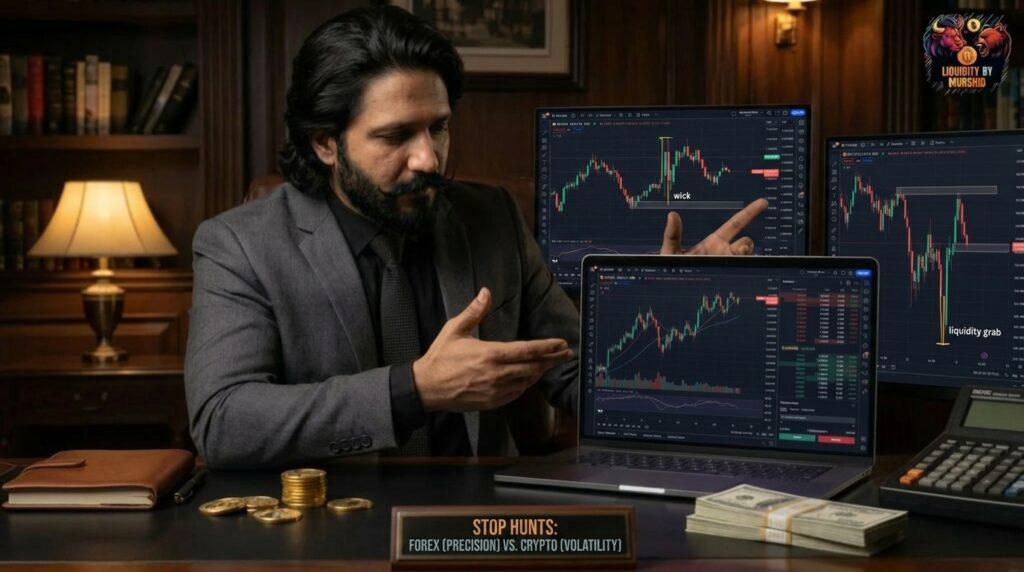
Stop Hunts in Crypto vs Forex (Complete 2026 Trading Guide)
Stop hunts are one of the most misunderstood concepts in trading. Many traders believe the market is moving randomly, while in reality, price often targets liquidity before making a real directional move.
In both crypto and forex markets, stop hunts occur when price moves into areas where retail traders place their stop losses. However, the way these stop hunts behave can differ significantly between the two markets.
Understanding these differences allows traders to avoid false entries, protect capital, and align with institutional behavior.
If you want to understand the foundation behind stop hunts, review common liquidity mistakes gold traders make.
What Is a Stop Hunt in Trading
A stop hunt occurs when price intentionally moves toward areas where traders have placed stop-loss orders.
These areas typically include equal highs, equal lows, previous highs or lows, and obvious support or resistance zones.
Once price reaches these zones, stop-loss orders are triggered, creating liquidity for larger players to enter or exit positions.
After collecting this liquidity, price often reverses or continues in the true intended direction.
Why Stop Hunts Happen
Markets require liquidity to move efficiently. Large institutions cannot execute large orders without sufficient counterparties.
Therefore, price is often driven toward areas where liquidity is concentrated.
Retail traders unknowingly provide this liquidity through their stop-loss placements.
As a result, stop hunts are not manipulation in the traditional sense. Instead, they are a natural function of how markets operate.
Stop Hunts in Forex Markets
Forex markets are highly liquid and are primarily driven by banks, institutions and central banks.
Because of this structure, stop hunts in forex are usually more controlled and structured.
Price often sweeps liquidity with precision before reversing.
For example, gold or major currency pairs frequently take out previous highs or lows during London or New York sessions before establishing the true move.
These movements are often aligned with macroeconomic events, such as interest rate decisions or inflation data releases.
Stop Hunts in Crypto Markets
Crypto markets operate differently from forex. They are less regulated and have lower overall liquidity compared to major forex pairs.
Because of this, stop hunts in crypto tend to be more aggressive and less predictable.
Large players, often referred to as whales, can move price more easily compared to institutional participants in forex markets.
As a result, crypto stop hunts can involve sharp spikes, sudden reversals and extended volatility.
Additionally, crypto markets operate 24/7, meaning stop hunts can occur at any time without the structure of traditional trading sessions.
Key Differences Between Crypto and Forex Stop Hunts
Although stop hunts exist in both markets, their behavior differs significantly.
- Forex stop hunts are usually more structured and session-based.
- Crypto stop hunts are often more volatile and unpredictable.
- Forex markets have deeper liquidity, making moves smoother.
- Crypto markets allow faster and sharper price manipulation due to lower liquidity.
Understanding these differences helps traders adapt their strategies depending on the market they trade.
How to Trade Around Stop Hunts
Instead of becoming a victim of stop hunts, traders can learn to use them as part of their strategy.
- Avoid placing stop losses at obvious levels such as equal highs or lows.
- Wait for liquidity sweeps before entering trades.
- Use confirmation such as market structure shifts after a stop hunt.
- Reduce risk during highly volatile conditions, especially in crypto.
If you want to improve your risk control further, review overleveraging the silent account killer.
Common Mistakes Traders Make with Stop Hunts
Many traders repeatedly fall into the same traps when dealing with stop hunts.
- Entering trades before liquidity is taken.
- Placing stop losses at obvious levels.
- Chasing price after a liquidity sweep.
- Ignoring market conditions and volatility.
Avoiding these mistakes significantly improves trading consistency.
Conclusion Stop Hunts Are Opportunities, Not Threats
Stop hunts are a natural part of how financial markets function. Instead of viewing them as manipulation, traders should understand their purpose.
Forex markets offer more structured stop hunts, while crypto markets present more aggressive and volatile movements.
By adapting to these differences, traders can position themselves alongside liquidity rather than against it.
Ultimately, mastering stop hunts allows traders to improve timing, reduce losses and trade with greater confidence.
To explore more liquidity-based strategies and trading insights, visit Liquidity By Murshid.