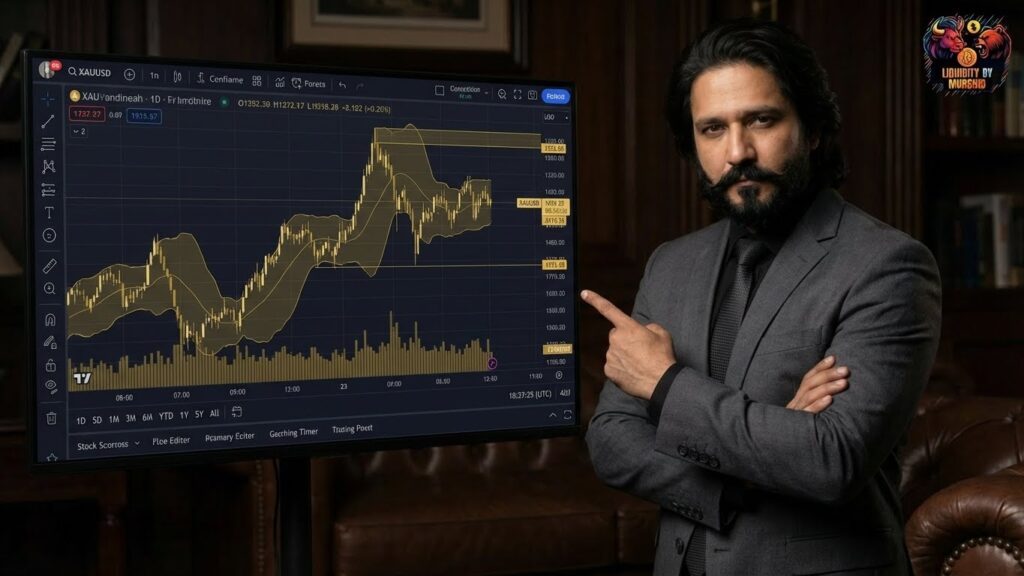
Best Timeframes for Trading XAUUSD Based on Volatility
XAUUSD is one of the most actively traded instruments in global financial markets. Its high volatility and fast price movement make it extremely attractive for intraday traders, scalpers, and smart money traders. However, many traders struggle because they do not understand how XAUUSD behaves differently across various timeframes. Each timeframe reflects a unique form of volatility, liquidity buildup, and institutional behavior.
Choosing the right timeframe is one of the most important decisions you can make when trading gold. Volatility increases and decreases during certain sessions, and price behaves differently depending on whether you are viewing the market from a macro, swing, intraday, or scalping lens. This makes timeframe selection a crucial component of developing a profitable strategy.
To master gold trading using institutional concepts and liquidity-based strategies, visit
Liquidity By Murshid for exclusive courses and advanced mentorship.
Understanding Volatility Behavior in XAUUSD
XAUUSD is known for its rapid and aggressive price movement. Unlike many forex pairs that move slowly or stay range-bound for hours, gold has the ability to move hundreds of points in a matter of minutes, especially during key economic events. This makes volatility a powerful tool in identifying which timeframe is ideal for your style.
Volatility in gold is influenced by several factors such as economic news releases, global uncertainty, inflation expectations, and liquidity shifts. According to volatility data from
Investing.com, gold consistently ranks among the highest-volatility trading instruments.
Because volatility changes throughout the day, certain timeframes become more effective depending on the session. Traders must understand how institutional liquidity interacts with key timeframes to optimize entries and avoid unnecessary losses.
The Importance of Timeframes in Liquidity Trading
Timeframes act as the lens through which you view market structure. The same chart can look completely different depending on the timeframe you choose. In liquidity trading and smart money concepts, each timeframe plays a specific role:
The higher timeframe sets the directional bias The intraday timeframe reveals the trading range The lower timeframe provides precise entries and stop placement
For gold, timeframe selection becomes even more important because of its sharp movements. Understanding where liquidity lies on each timeframe helps traders anticipate breakouts, liquidity sweeps, and reversal points.
This is why professional traders often combine multiple timeframes instead of relying on just one. The goal is to align structure, volatility, and liquidity into one consistent narrative.
Why Higher Timeframes Are Essential for Gold Traders
Higher timeframes such as the Daily D1 and Four-Hour H4 provide the clarity that lower timeframes cannot. Gold often creates its long-term liquidity runs and macro structure on these timeframes. Large institutions place their biggest orders at these levels.
On higher timeframes, traders can identify:
Deep supply and demand zones Major liquidity pools Long-term trend structure Institutional order blocks Fair value gaps with high significance
Even if you are a scalper, analyzing higher timeframes is essential before taking any trade. Gold respects these levels with high precision, often reacting with violent reversals or strong continuations.
Higher timeframes show the true intent of the market, while lower timeframes show the execution.
The Four Hour Timeframe for XAUUSD Volatility Cycles
The H4 timeframe is one of the most reliable for identifying gold's volatility cycles. It balances macro structure with intraday movement and shows clear liquidity shifts. Many institutional traders and large swing traders rely heavily on H4 when analyzing gold.
Gold often forms:
Strong H4 candles during high-impact economic sessions Clear momentum trends Well-defined swing highs and swing lows High-value liquidity zones
The H4 timeframe is perfect for identifying key levels where volatility will expand during London and New York sessions. Traders who want to hold trades for several hours often use H4 as their main directional tool.
The One Hour Timeframe for Intraday Direction
The H1 timeframe is one of the best for intraday XAUUSD trading. It shows clear session transitions, liquidity buildup, and trend changes. Gold’s volatility becomes more readable on the H1 chart compared to higher timeframes.
The H1 timeframe helps traders identify:
Session highs and lows Break of structure confirming direction Premium and discount pricing zones Liquidity sweeps before major moves
This timeframe is ideal for traders who prefer fast but controlled movements. It presents a balance of clarity and volatility without the noise of lower timeframes.
The Fifteen Minute Timeframe for Entry Timing
The M15 timeframe is highly effective for traders who want to refine entries and capture intraday moves. It shows liquidity engineering more clearly, especially during London Open and New York Open.
On the M15 chart, gold often forms:
Clean liquidity sweeps Inducement patterns Fair value gap entries Change of character signals
Many liquidity traders rely heavily on M15 for identifying precise kill zones where volatility expands quickly. It provides just enough detail without overwhelming noise.
The Five Minute Timeframe for Precision Entries
The M5 timeframe is where institutional precision becomes visible. Gold's reaction to liquidity levels becomes sharp and clear at this scale. Traders looking for sniper-style entries use M5 to refine positions.
The M5 timeframe shows:
Rejection wicks at liquidity zones Micro fair value gaps Break of structure for confirmation Price manipulation at session opens
While M5 is powerful, it should never be used alone. It must always be supported by H1 or H4 directional bias.
The One Minute Timeframe for Scalpers
The M1 timeframe is extremely volatile and is suitable only for advanced traders. Gold moves so fast on M1 that liquidity sweeps and micro-structures form within seconds.
Scalpers using M1 look for:
Tiny liquidity pools Micro structure breaks Fair value imbalance fills Session open volatility
However, without a higher timeframe narrative, M1 becomes dangerous because gold can sweep both sides multiple times in minutes.
Which Timeframe Is Best for XAUUSD
There is no single perfect timeframe for trading gold. The best approach is combining multiple timeframes to form a clear directional and liquidity-based narrative.
For most traders:
D1 and H4 determine direction H1 gives structure M15 gives confirmation M5 or M1 gives precision entry
This multi-timeframe approach helps traders enter with confidence and avoid emotional trading driven by volatility spikes.
Conclusion Choosing the Best Timeframe for Trading XAUUSD
XAUUSD’s volatility makes it one of the most exciting yet challenging assets to trade. Understanding how gold behaves on different timeframes is essential for developing a winning strategy. Whether you are a swing trader analyzing H4 or a scalper working on M1, each timeframe has a purpose.
The key is learning how volatility shifts throughout the day and how institutions engineer liquidity on each timeframe before making major moves. Once you understand this structure, gold becomes one of the most predictable instruments in the market.
To learn how to trade gold using institutional methods and liquidity-based strategies, explore the advanced programs available at
Liquidity By Murshid.