
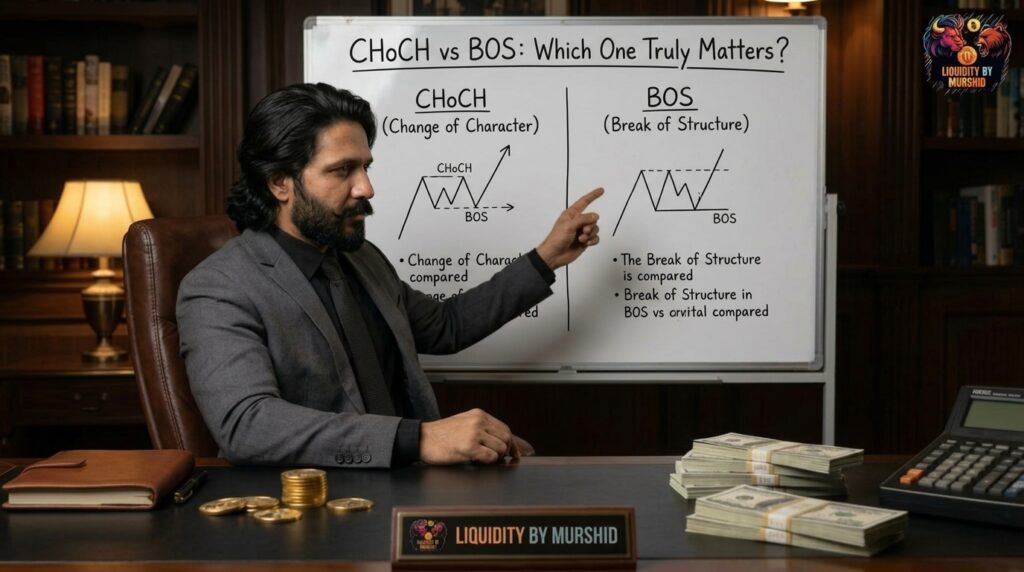
CHoCH vs BOS: Which One Truly Matters In Forex Trading? (2026 Market Perspective)
In modern forex trading, structure plays a central role in decision making. Two of the most discussed structural concepts are Change of Character (CHoCH) and Break of Structure (BOS). While both signals appear frequently on price charts, many traders misunderstand their real purpose.
In 2026 markets, where algorithmic execution and liquidity sweeps dominate price delivery, understanding the difference between CHoCH and BOS can dramatically improve trade timing and bias building.
However, traders often treat these signals as identical confirmations. In reality, each serves a different role within market structure analysis.
What Is Break Of Structure (BOS)?
Break of Structure represents continuation of an existing trend. When price breaks a previous swing high in an uptrend or a previous swing low in a downtrend, it confirms that the dominant direction remains intact.
Therefore, BOS signals momentum continuation rather than a reversal.
For example:
- In an uptrend, price breaks the previous higher high.
- In a downtrend, price breaks the previous lower low.
- Momentum confirms the trend remains active.
Because institutions build positions during trending phases, BOS often appears during strong directional moves.
What Is Change Of Character (CHoCH)?
Change of Character signals a potential shift in market direction. Instead of confirming continuation, CHoCH suggests the existing trend may weaken or reverse.
Typically, CHoCH occurs when price breaks the most recent structural point opposing the current trend.
For instance:
- In an uptrend, price breaks a higher low.
- In a downtrend, price breaks a lower high.
- Market sentiment begins shifting.
However, CHoCH alone does not guarantee a full reversal. Instead, it signals that traders should monitor price behavior more closely.
Why Many Traders Misinterpret CHoCH
A common mistake occurs when traders treat every CHoCH as a confirmed trend reversal. In reality, markets frequently produce temporary structural shifts before continuing the original trend.
In 2026 forex markets, liquidity sweeps often create false CHoCH signals. Institutions may briefly break structure to trigger stops before resuming directional movement.
Understanding liquidity behavior helps traders avoid these traps. For example, see internal vs external liquidity explained.
How BOS Confirms The Real Direction
While CHoCH signals a possible shift, BOS confirms the true directional continuation.
Professional traders often wait for BOS after a CHoCH before committing to a new bias.
This sequence commonly occurs:
- Liquidity sweep triggers structural break.
- CHoCH signals potential shift.
- BOS confirms the new trend direction.
As a result, BOS provides stronger confirmation for directional trades.
How Institutional Traders Combine Both Signals
Professional traders rarely rely on a single signal. Instead, they analyze structure alongside liquidity and imbalance.
Typically, the process includes:
- Liquidity sweep around equal highs or lows.
- CHoCH indicating possible trend shift.
- BOS confirming directional continuation.
- Entry during retracement or imbalance.
Fair Value Gaps often provide those retracement zones. Learn more in fair value gaps vs liquidity zones.
Which One Truly Matters?
Both signals serve important purposes, yet they operate differently.
CHoCH provides early warning that market conditions may change. Meanwhile, BOS confirms the direction institutions are actively pushing price.
Therefore, traders should treat CHoCH as preparation and BOS as confirmation.
Conclusion Structure Must Align With Liquidity
CHoCH and BOS are powerful structural tools when used correctly. However, structure alone cannot explain market behavior.
Successful traders combine structure analysis with liquidity awareness, session timing and disciplined risk management.
Ultimately, understanding how these elements interact allows traders to align with institutional order flow instead of reacting emotionally.
To learn more about liquidity-based trading frameworks and execution models, visit Liquidity By Murshid.